

For years, the hobby rewarded accumulation.
More boxes. More breaks. More slabs. More parallels. More mail days.
The thrill was often in what came next.
The next pack. The next break. The next hit.
And make no mistake—there is still something special about ripping open a pack and not knowing what's inside. That feeling is part of what made many of us collectors in the first place.
But something interesting is happening in 2026.
As the hobby matures, so are many of the people in it.
Serious collectors are beginning to ask a different question.
Not:
"What should I buy next?"
But:
"What actually belongs in my collection?"
That's a very different way to collect.
And it may be one of the healthiest shifts the hobby has seen in years.
From Accumulation to Intention
Most collections start the same way.
You buy what you like.
Then you buy some more.
A favorite player becomes five cards. Five becomes twenty. You start chasing rookies. Then autographs. Then numbered parallels. Maybe vintage catches your attention. Maybe you start grading.
Before long, you've got cards everywhere.
Some are valuable.
Some are sentimental.
Some you don't even remember buying.
That's collecting.
But eventually, some collectors reach another stage.
Curation.
Curation means looking at everything you've accumulated and deciding what actually matters.
Maybe you're building the definitive collection of one player.
Maybe it's Hall of Fame rookies.
Maybe it's vintage baseball.
Maybe it's Jordan, Griffey, Brady or Ohtani.
Maybe it's cards connected to moments you experienced with your father, your kids or your favorite team.
The category doesn't matter.
What matters is that the collection begins to have a point of view.
The Hobby Is Becoming More Selective
The market itself appears to be moving in a similar direction.
The wild speculation that characterized parts of the 2020–2022 boom has given way to a more mature market in which collectors have access to better sales data, population reports, grading information and historical pricing.
Grading itself has become more selective. Rising costs and changing economics mean collectors have more reason to ask whether a card actually deserves to be graded rather than automatically sending everything in.
Vintage remains strong at the upper end of the hobby, while modern collecting has become increasingly selective around important rookies, scarce parallels, autographs and truly significant cards.
The hobby hasn't stopped chasing.
Collectors are simply becoming better at deciding what is worth chasing.
The Chase Isn't Going Away
And it shouldn't.
Breaking is fun.
Ripping wax is fun.
Walking into a card show with money in your pocket and absolutely no idea what you're going to leave with is fun.
That's the hobby.
But there's a difference between enjoying the chase and allowing the chase to define the collection.
The endless cycle of ripping, breaking and chasing the next big card has even begun attracting attention outside the hobby because of how closely some of those experiences can resemble gambling.
That doesn't mean collectors should stop opening boxes.
It means there's value in occasionally asking:
Am I building my collection—or just feeding the next chase?
Those are two very different things.
Buy the Card You Actually Want
There's a wonderfully simple idea gaining relevance again:
Buy the card, not the box.
Instead of spending hundreds—or thousands—hoping to pull a particular player, autograph or parallel, more experienced collectors understand the power of simply finding the card they actually want.
It's less exciting for thirty seconds.
But it can be far more satisfying for thirty years.
That's especially true once you know what your collection is becoming.
A collector building an Ohtani collection doesn't need every Ohtani card ever produced.
A collector building around baseball history doesn't need every vintage card.
A Jordan collector doesn't need every insert.
The goal isn't necessarily completeness.
The goal is significance.
The Best Collections Tell a Story
Walk through a museum and you'll notice something.
They don't show you everything they own.
Museums can have hundreds of thousands—or millions—of objects in their archives.
Only a fraction are displayed.
Why?
Because displaying everything would diminish the things that matter most.
The same principle applies to collecting.
Your best collection may not be the collection with 5,000 cards.
It might be the collection with 25 cards where every single card means something.
Your first major purchase.
The rookie of the player who made you love the game.
The card you searched five years to find.
The autograph you bought with your son.
The vintage card you've wanted since childhood.
The one you said you'd never sell.
Those cards aren't inventory.
They're your collection.
And there's a difference.
Then Comes the Question Every Serious Collector Eventually Faces
Once you determine which cards matter most, something else changes.
You want to see them.
Not buried inside a storage box.
Not sitting in a safe where you look at them twice a year.
Not stacked on a desk.
You spent years searching for them.
You researched them.
You negotiated for them.
You protected them.
You may have spent more on a single card than you once imagined spending on an entire collection.
So why shouldn't you enjoy them?
That's where collecting starts becoming something bigger.
The collection becomes part of your environment.
Your office.
Your card room.
Your game room.
Your home.
And suddenly you're not simply storing collectibles.
You're telling your story.
From Card Collection to Personal Museum
This might be the next evolution of the hobby.
The personal sports museum.
Not necessarily a massive room filled floor-to-ceiling with memorabilia.
It could be one wall.
One cabinet.
Ten cards.
A signed baseball.
A game-used jersey.
A few photographs.
The ticket from a game you'll never forget.
The beauty is that no two should look the same.
A Yankees collector's room shouldn't look like a Dodgers collector's room.
A vintage collector shouldn't necessarily display a collection the same way someone collecting modern refractors does.
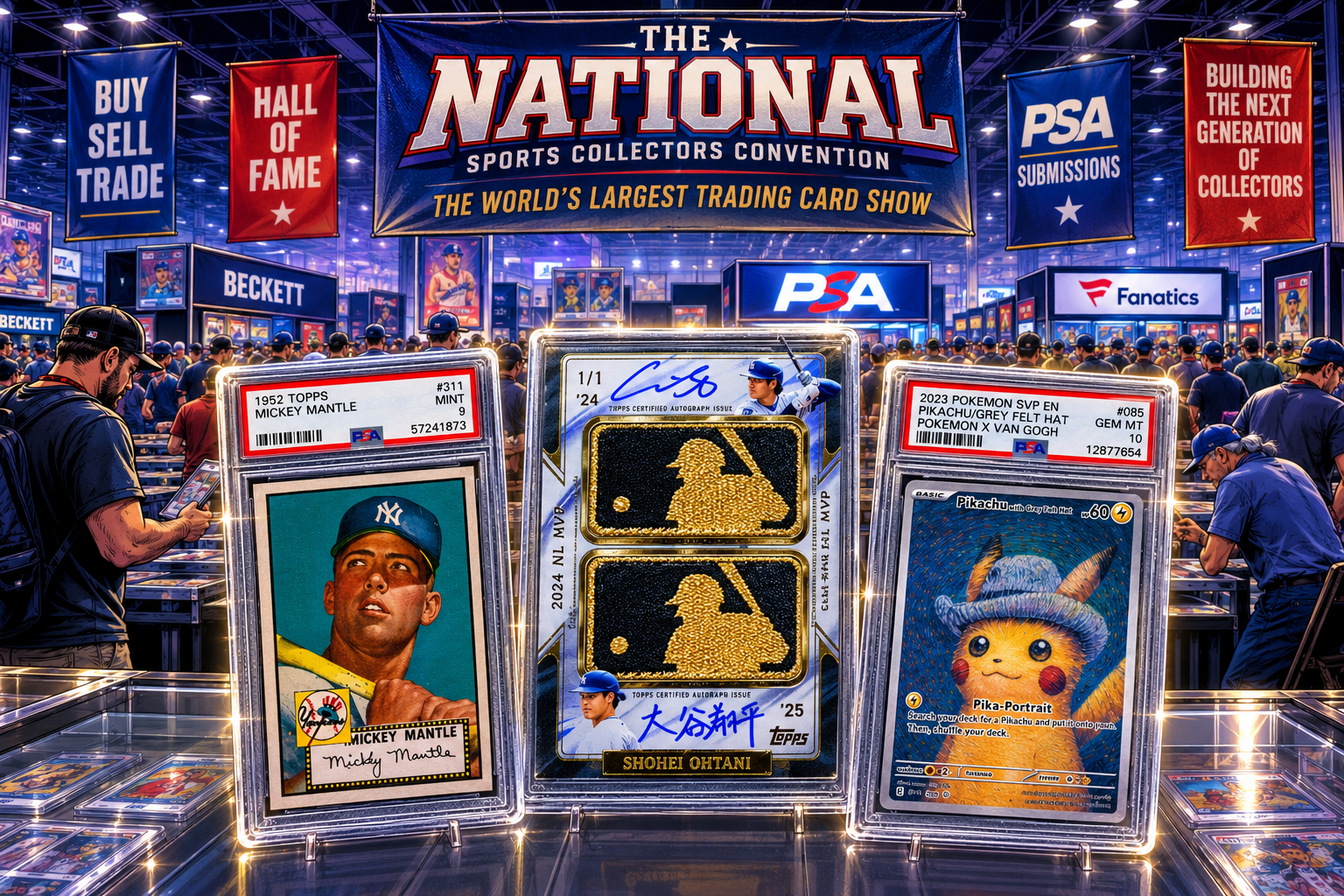
And a collector whose centerpiece is a 1952 Mantle has a completely different story than someone building around Shohei Ohtani.
That's what makes it personal.
Your collection should look like your collection.
Display Changes the Way You Collect
There's another interesting thing that happens once you start displaying a collection properly.
You become more selective.
Space is finite.
When there are only twelve spaces in a display, suddenly the thirteenth card has to earn its way in.
You start asking better questions.
Does this improve the collection?
Does this card mean more to me than something already displayed?
Would I rather own five average cards—or put that money toward one exceptional card?
That is curation.
And ironically, having less space can result in a better collection.
Because the objective changes from acquiring more to acquiring better.
Your Collection Deserves More Than Storage
At Claw & Crown, this is the part of collecting that fascinates us.
Because we don't believe the final destination of a great collection should be a cardboard box.
We believe collections should be experienced.
The craftsmanship of the display should complement the craftsmanship, history and significance of what's inside it.
Whether your collection is worth $5,000 or $500,000 isn't really the point.
If you've spent years building it, there is probably a story behind it.
And those stories deserve to be seen.
That's why we build handcrafted displays designed around the collection—not the other way around.
Because at some point, every collector has to decide:
What deserves a place in the collection?
And then comes an even better question.
What deserves a place on the wall?
Curate More!
Keep ripping.
Keep hunting.
Keep going to shows.
Keep chasing the cards that make this hobby fun.
But every once in a while, look at what you've already built.
Pull out the cards that mean the most.
Put them together.
You may realize you don't need another box.
You may already have something much better.
A collection worth showing.
Robert & Greg
The C&C team

Leave a comment
This site is protected by hCaptcha and the hCaptcha Privacy Policy and Terms of Service apply.